
Choosing an installer at a glance
The short answers. Each links to the detail further down.
| Question | Short answer |
|---|---|
| What must an installer have? | MCS certification. Without it you can't get Smart Export Guarantee payments. Checks |
| What else should I check? | A consumer code (RECC or HIES), an electrical scheme (NICEIC or NAPIT), insurance and the company record. Checks |
| How many should I talk to? | Three, and ask each for a like-for-like quote. Finding one |
| How do I read reviews? | Look for patterns in recent independent reviews, especially about aftercare. Reviews |
| How long does fitting take? | Usually 1–2 days. Installation day |
| What does PowerPilot check? | The MCS register, insurance, the Companies House record and reviews. Our checks |
How to find a reliable local installer
Build a shortlist, then narrow it down on accreditations, reviews and a conversation or two. Most people find installers through local searches, recommendations from neighbours, scheme directories such as MCS and TrustMark, or a matching service like PowerPilot.
Shortlist installers who cover your area
Use your postcode on the MCS register or a matching service, so you only talk to firms that actually work near you.
Check their accreditations
MCS certification first, then a consumer code, an electrical scheme and insurance. Most take a minute on a public register.
Read recent reviews
Look at communication, workmanship and, above all, how they handled problems.
Get three like-for-like quotes
Compare designs, warranties and how each installer explains things, not only the price.
Your part: your yearly electricity use from a bill, and photos of your roof and fuse box.
Not sure solar suits your home yet? Start with solar panels for your home.
Accreditations and checks
The quickest way to rule out a risky installer is to check these before you go any further.
| Check | What it tells you | How to check |
|---|---|---|
| MCS certification | Their solar designs and installations are independently assessed. You need an MCS-certified installation to get Smart Export Guarantee payments. | Search the MCS installer register |
| RECC or HIES | They've signed up to a consumer code covering sales, contracts, deposits and complaints. MCS installers must belong to one. | Search the RECC or HIES member list |
| TrustMark | A government-endorsed quality scheme covering competence, trading and customer service | Search the TrustMark register |
| NICEIC or NAPIT | Their electrical work is assessed, and they can self-certify it under Building Regulations | Search the scheme's register |
| Public liability insurance | Damage or injury during the work is covered | Ask for the certificate |
| Companies House | The company is active and how long it has traded | Search the company on Companies House |
Reviews and red flags
Reviews show how an installer treats customers before, during and after the work. Look on Google and other map listings, independent review sites and comparison sites, and focus on patterns in recent comments rather than single stories.
Good signs
- Calls and emails answered, expectations set clearly
- Tidy work, no leaks, systems performing as promised
- Problems put right quickly, with the company replying to complaints
Red flags
- Few independent reviews despite years of trading
- "Sign today" discounts or high-pressure sales
- Repeated complaints about faults or unfinished work, with no reply
- Hard to reach once paid
Questions to ask every installer
- Are you MCS-certified, and which consumer code are you a member of?
- Will your own team fit the system, or subcontractors?
- What warranties do you give on workmanship, and are they insurance-backed?
- Who do I contact if something goes wrong, and how quickly do you respond?
- Can you tell me about a recent problem and how you put it right?
How PowerPilot matches you
PowerPilot is a free comparison service. You tell us your type of home, what you're after (panels, panels and a battery, or a battery alone), whether you own it and when you'd like it fitted. We introduce you to up to three installers who cover your area; they contact you to arrange a survey and quote, and you choose.
We don't design systems, set prices or sit in your contract, and you're free to choose any installer, including one you found elsewhere. To get a feel for prices first, see solar panel cost in the UK or how to compare solar panel quotes.
Installation day
Most home systems are fitted in one or two days, depending on size, roof access and whether there's a battery.
Arrival and scaffolding
The team confirms the plan with you. Scaffolding usually goes up beforehand or first thing.
Your part: clear access to the loft, the fuse box and the driveway.
Roof work
Mounting rails are fixed to the roof structure, then the panels are fitted and wired together.
Electrical work
Indoors, they fit the inverter, isolators and monitoring, and connect to your consumer unit. A battery goes in at this stage.
Your part: agree where the inverter, battery and any visible cabling go.
Testing and handover
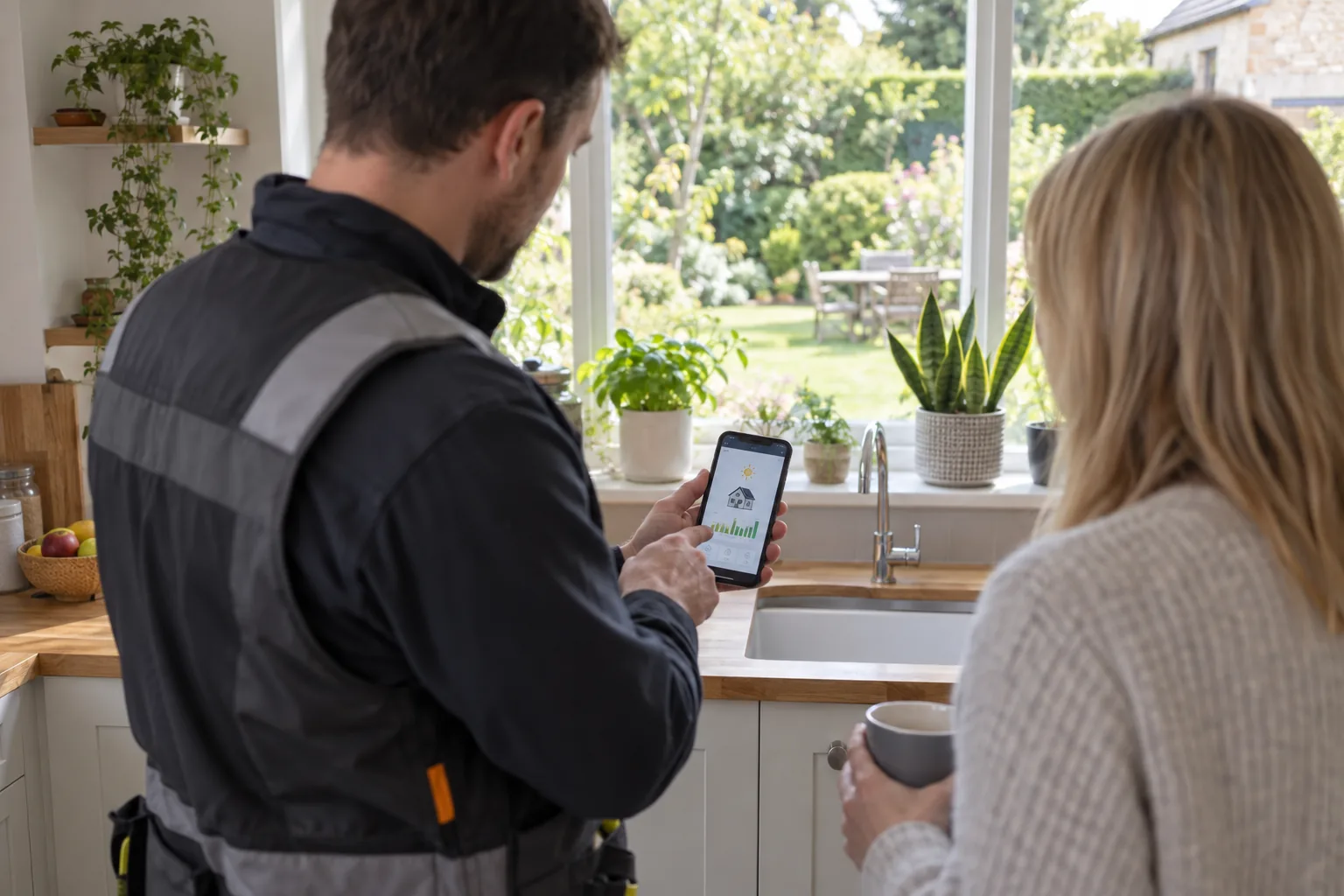
The system is tested and commissioned. The installer should show you how to switch it off safely and how the monitoring works.
Fitting a business? See commercial solar installation.
After installation
You should receive a set of documents soon after. Keep them together, with digital copies: you'll need them for export payments, warranty claims and if you sell the house.
- MCS certificate
- Electrical installation certificate
- Building Regulations compliance
- Confirmation your network operator was told
- Panel, inverter and battery warranties
- Workmanship warranty
- User manuals
Product warranties come from the manufacturers and cover faulty equipment. The workmanship warranty comes from the installer and covers how it was fitted, such as leaks or poor fixings. Ask who you contact first if the system stops working, and who deals with the manufacturer.
With your MCS certificate you can apply to an energy supplier for a Smart Export Guarantee tariff, which pays for the power you export. Rates vary widely between suppliers, so compare them.
Frequently asked questions
How do I choose a reputable solar panel installer near me?
Check they're MCS-certified and members of a consumer code such as RECC or HIES, read recent independent reviews, and get like-for-like quotes from three installers. A matching service can introduce you to installers who cover your area.
Why does MCS certification matter?
MCS means the installer's designs and installations are independently assessed. You need an MCS-certified installation to get Smart Export Guarantee payments for the power you export.
What should I watch out for in installer reviews?
Patterns in recent reviews: high-pressure sales, poor communication, unresolved faults and being hard to reach after payment. Very few independent reviews for a firm that claims years of trading is also a warning sign.
How long does solar panel installation take?
Usually one or two days for a home, a little longer with a battery. Scaffolding often goes up the day before.
How does PowerPilot match me with installers?
You tell us your type of home, what you're after and when. We introduce you to up to three installers who cover your area, each with their MCS certification, insurance and Companies House record checked. It's free.