
Commercial solar at a glance
The short answers to what most businesses ask first. Each links to the detail further down.
| Question | Short answer |
|---|---|
| What does it cost? | Roughly £800–£1,200 per kWp installed; about £40,000–£60,000 for a 50 kWp system. Costs |
| How fast does it pay back? | Often 4–8 years where most power is used on site in the day. Payback |
| How long does it take? | 6–16 weeks from enquiry to switch-on; days to a few weeks on site. Timeline |
| Will it disrupt my business? | Usually little: work is zoned and power shutdowns are short and pre-agreed. Disruption |
| Do I need planning permission? | Rarely for rooftops (permitted development); more often for ground-mounted arrays and listed buildings. Planning |
| Can I avoid paying upfront? | Yes. A PPA or finance can mean little or no capital outlay. Funding |
| Does PowerPilot install it? | No. We match you with up to three vetted installers, free. How we work |
What is commercial solar panel installation?
Commercial solar panel installation is the end-to-end delivery of a solar PV system for a non-domestic site: design, permissions, hardware, construction, grid connection and handover.
Compared with home solar, commercial systems are larger (typically 30 kWp to several MW), face stricter structural and electrical checks, and often use more complex funding such as PPAs, leases or capex approval.
- PanelsTurn daylight into DC power
- InverterConverts it to AC for your site
- Distribution boardFeeds your lights, machines and chillers first
- GridSurplus exported and paid for under the SEG
Optional battery: stores midday surplus for evenings, cuts peak demand charges and keeps critical circuits running in a power cut.
Types of commercial solar system
| Type | Best for | Good to know |
|---|---|---|
| Rooftop | Offices, warehouses, factories, schools, retail units | The most common and usually cheapest per kWp. Needs a sound roof with 25+ years of life left. |
| Ground-mounted | Spare land, fields, large campuses | Free of roof limits and easy to maintain, but more likely to need planning consent. |
| Solar car port | Staff and customer car parks | Generates and shades at once, and pairs well with EV charging. Costs more per kWp. |
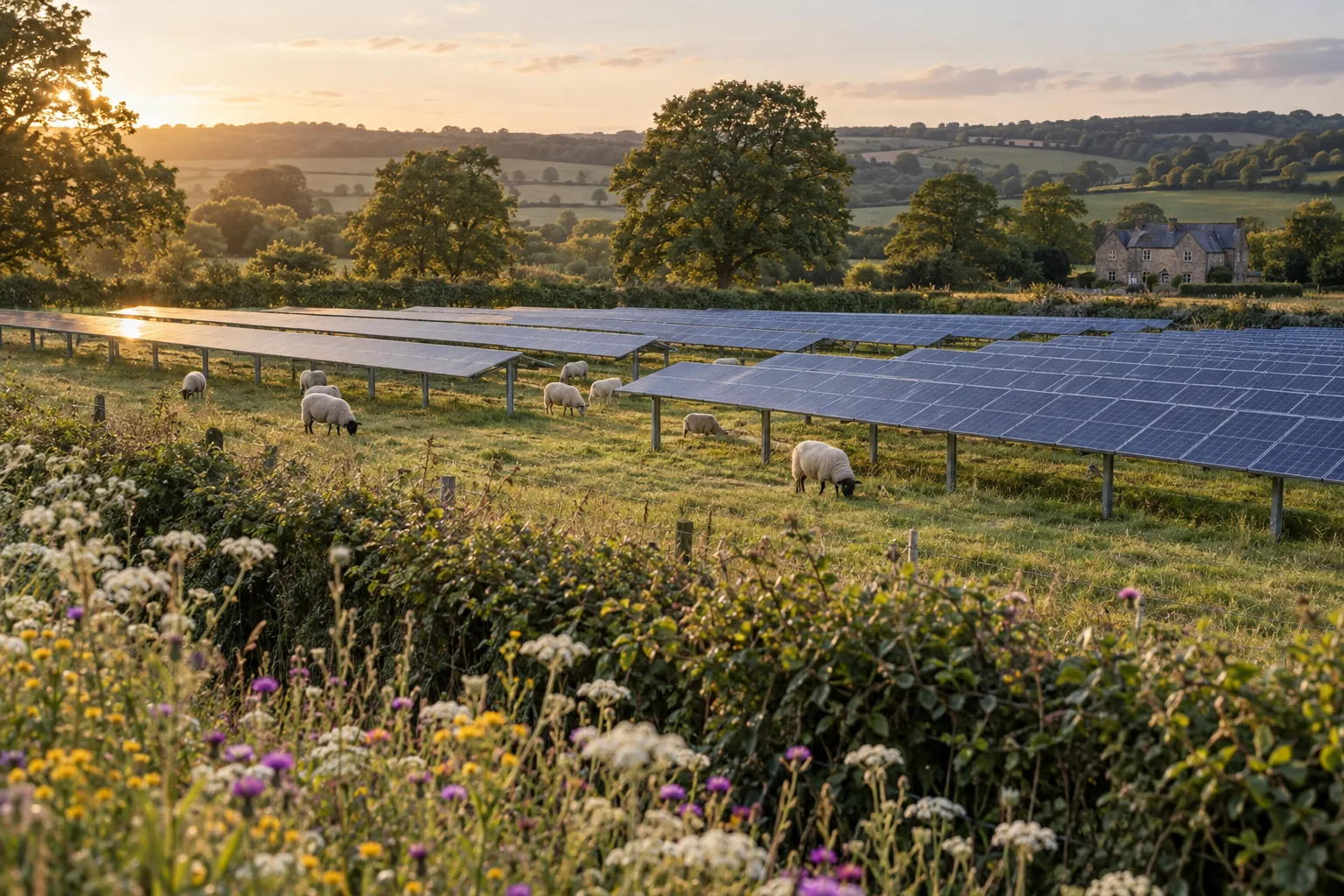
A full system includes panels, mounting, inverters, cabling, monitoring and metering, and sometimes batteries and smart controls. Farms often combine barn roofs with ground-mounted rows: see solar panels for farms.
Is commercial solar right for your business?
Solar pays best where the power it makes is used on site, in daylight, for years to come.
A strong fit
- High daytime electricity use (roughly 8am–6pm)
- A sound roof or land with little shading
- You own the site or hold a long lease
- Pressure to cut Scope 2 emissions or meet ESG targets
A weaker fit
- Most use is at night and can't be shifted
- The roof is near end of life or structurally weak
- You expect to move within a few years
- The local grid is already constrained for export
Sectors that typically do well:
- Manufacturing and food processing
- Logistics and cold storage
- Supermarkets and retail warehousing
- Leisure centres
- Farms and agri-businesses
- Schools, colleges and hospitals
- Councils and public buildings
For where solar works across different kinds of business, see commercial solar for UK businesses.
Commercial solar installation costs in the UK
Cost is driven mainly by system size (kWp), roof type, access, structural works and any grid upgrades or export-limiting controls. Flat roofs and simple pitched roofs usually cost less per kWp than complex or fragile ones, and larger systems cost less per kWp than small ones.
Example system cost scenarios
| System size | Typical site | Approx. installed cost | Generation per year | Indicative payback |
|---|---|---|---|---|
| 50 kWp | Small factory or office | £40,000–£60,000 | 45,000–55,000 kWh | 5–8 years |
| 250 kWp | Medium warehouse | £180,000–£280,000 | 225,000–275,000 kWh | 4–7 years |
| 1 MW | Large warehouse or ground mount | £650,000–£1,000,000+ | 900,000–1,100,000 kWh | 4–7 years |
Figures are indicative; real quotes depend on survey, grid and funding.
Worked example: a 250 kWp warehouse
- Generation: 250 kWp × 930 kWh per kWp
- 232,500 kWh
- Used on site (80%) at 25p per kWh
- £46,500
- Exported (20%) at 5p per kWh (SEG)
- £2,325
- Saving in year one
- £48,825
- Installed cost at £900 per kWp
- £225,000
- Simple payback
- about 4.6 years
- CO₂ avoided (0.207 kg per kWh)
- about 48 tonnes a year
Assumptions: an unshaded, south-facing roof; your unit rate stays at 25p; no tax relief, finance costs or panel ageing. Change any of them in the calculator below.
Estimate your system, cost and payback
Four numbers from your electricity bill and site. The result is an estimate to compare quotes against, not a quote.
How we work this out
- Size: 0.15 kWp per m² of usable roof or land, capped so the system makes no more than 80% of your annual use.
- Generation: kWp × typical yield for your region (South West England 1,000, London and South East 980, East of England 960, Midlands and Wales 930, North of England 880, Scotland and Northern Ireland 840 kWh per kWp a year). Shading, orientation and tilt move this by ±10%.
- Saving: 80% of generation used on site at your unit rate; the rest exported at 5p per kWh (a typical Smart Export Guarantee tariff).
- Cost: £1,000 per kWp up to 100 kWp, £900 per kWp up to 500 kWp, £800 per kWp above that, shown as a ±15% range. Roof works, grid upgrades and batteries are extra.
- Payback: mid-range cost ÷ first-year saving. No tariff rises, panel ageing, finance costs or tax relief are included.
- CO₂: generation × 0.207 kg CO₂e per kWh of grid electricity (DESNZ 2024 conversion factors).
Payback periods and what drives them
Well-matched commercial installations typically pay back in 4–8 years. What moves it:
| Factor | Shortens payback | Lengthens payback |
|---|---|---|
| On-site use | Most power used in the day | Lots exported at low SEG rates |
| Tariff | High or rising unit rates | Cheap fixed-rate contracts |
| System size | Larger systems, lower cost per kWp | Small, complex installs |
| Funding | Paying upfront (capex) | PPA or finance (lower total saving) |
| Extras | Batteries where export is capped | Batteries with little evening demand |
For a deeper look at pricing, see commercial solar panel cost in the UK: prices per kWp and payback.
The installation process, step by step
Seven stages from first enquiry to handover. Most of the waiting is on paperwork and the grid; the build itself is the short part.
Enquiry and desktop assessment
The installer uses mapping tools to estimate roof area, orientation and shading, then sizes a provisional system with a first view of savings and payback.
Your part: address, 12 months of electricity bills (kWh and £), roof plans or photos and operating hours.
Site survey and feasibility
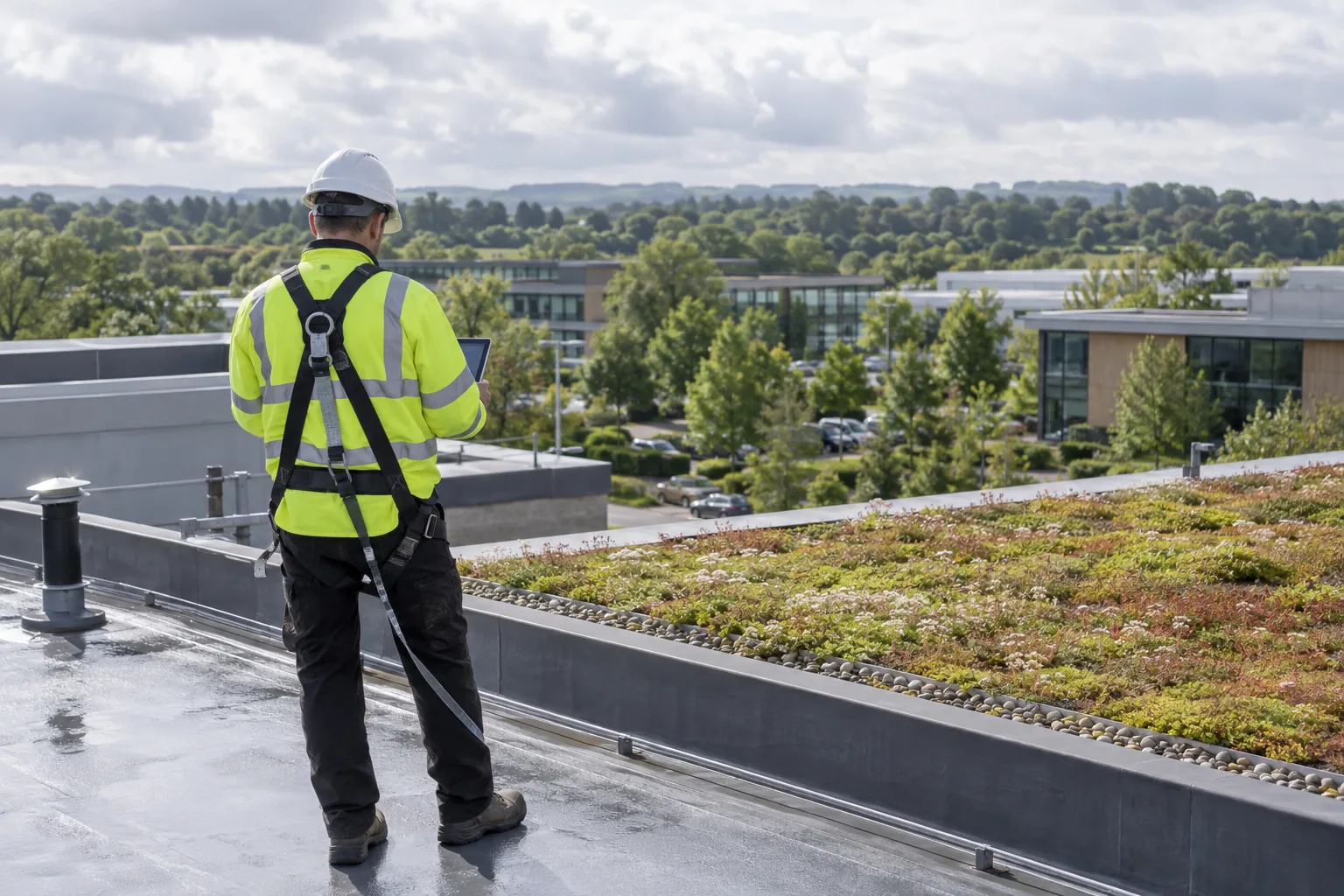
Engineers inspect roof condition and structure, electrical boards and meters, shading, cable routes, access and health and safety. A structural engineer's report may follow.
Your part: site access, existing drawings and any no-go zones.
Design and financial modelling
Final panel layout, mounting and inverter design, with modelled generation, self-consumption, export, payback, IRR and carbon savings for each funding option.
Your part: review the design, choose capex, finance or PPA, and approve.
Grid application and permissions
Most commercial systems need a G99 application approved by your Distribution Network Operator (DNO) before installation. It can take several weeks, and the DNO may cap export. If capacity is tight, export limiting, a battery or a smaller system can solve it.
Your part: usually nothing; the installer applies.
Roof or ground works
Scaffolding or access platforms go up, then mounting rails or ballast frames, then panels, to structural and wind-load requirements.
Your part: agree working hours and restricted areas so operations carry on safely.
Electrical works and connection
Inverters, cabling, isolators and protection go in, connected to your distribution board with monitoring and any export controls. Short shutdowns are booked outside peak hours.
Your part: approve planned outages in advance.
Testing, commissioning and handover
Electrical tests to BS 7671, commissioning, export settings confirmed with the DNO, then as-built drawings, warranties, an O&M manual and training.
Your part: receive monitoring logins and agree the maintenance plan.
How long it takes, and how much it disrupts
From first enquiry to switch-on, most projects take 6–10 weeks for smaller rooftop systems and 8–16+ weeks for larger or complex sites. DNO approval, structural checks and planning are the main variables.
Timeline by system size
| System size | Enquiry to switch-on | Time on site | Typical disruption |
|---|---|---|---|
| 50 kWp | 6–10 weeks | 3–5 days | Low |
| 250 kWp | 8–14 weeks | 7–15 days | Low to moderate |
| 1 MW | 10–16+ weeks | 15–25 days | Moderate |
Keeping disruption low
A good installer plans scaffolding and deliveries around key access routes, uses segregated work zones, books shutdowns out of hours and coordinates with your health and safety and operations teams. Teams usually work standard weekday hours, with noisy work moved outside your busiest times by agreement.
Funding, PPAs and ownership
How you pay changes how much you save, who owns the system and who looks after it.
| Buy outright (capex) | Finance or lease | Fully funded PPA | |
|---|---|---|---|
| Upfront cost | Full system cost | Little or none | None |
| Who owns it | You, from day one | You (finance) or the lender (lease) | The funder |
| What you pay | Nothing ongoing | Fixed monthly payments | An agreed rate per kWh, usually below your grid tariff |
| Maintenance | You, often via an O&M contract | Usually you | The funder |
| Lifetime saving | Highest | Middle | Lowest, but immediate |
| Best for | Cash-rich owners wanting the best return | Owners preserving cash | Sites wanting savings without capital or risk |
A PPA is a long contract on the property, often 10–25 years, so it needs legal review and landlord consent where you lease.
Tax reliefs and incentives
UK businesses may benefit from capital allowances on qualifying solar assets, the Smart Export Guarantee (SEG) for exported power, and occasional regional or sector grants. Schemes change, so check current guidance and take tax advice. See solar panel grants for businesses in the UK (2026).
Regulations and compliance
Your installer handles most of this, but it helps to know what a compliant project covers.
| Requirement | What it covers | Who handles it |
|---|---|---|
| Building Regs Part A (structure) | Panels and mounting (typically 10–20 kg/m² plus wind uplift) must not overload the roof | Installer, with a structural engineer on larger or older roofs |
| Building Regs Part B (fire) | Arrays keep fire-fighting access clear; cable routes keep fire integrity | Installer and building control |
| Building Regs Part P and BS 7671 | Safe electrical design, isolation, labelling and emergency shutdown | Qualified (often NICEIC-approved) electricians |
| G99 grid connection | DNO approval for the system to connect and export | Installer applies; DNO decides |
| Planning | Permitted development for most rooftops; consent for many ground mounts and listed or sensitive sites | Installer flags early; you or the installer applies |
Planning permission and permitted development
Many rooftop installations fall under permitted development, so no full planning application is needed, provided they don't protrude excessively above the roof, aren't on listed buildings or in certain conservation areas, and meet siting and glare requirements. Ground-mounted systems, listed buildings and visually sensitive sites are more likely to need consent.
The "20% rule" for solar
The "20% rule" is not a formal regulation. People usually use it to mean keeping panels to a modest share of the roof so they don't dominate the building's appearance and stay within permitted development. Local planning authorities apply their own judgement, so ask your installer how it applies to your site.
Performance, monitoring and maintenance
Commercial systems come with online monitoring as standard: live and historical generation, bill and CO₂ savings, and alerts when output drops. Many businesses feed it straight into ESG reporting or a reception display.

Solar PV has no moving parts, so maintenance is light: an inspection of fixings, cabling and inverters once or twice a year, and cleaning where dirt builds up (near roads, farms or the coast). Both are often covered by an O&M contract.
Common issues and fixes
| Issue | What you'll see | The fix |
|---|---|---|
| Soiling (dirt, bird droppings) | A gradual drop in output | Periodic cleaning |
| New shading | Lower output at certain times of day | Trim trees or redesign affected strings |
| A failed string | A sudden, lasting drop on part of the array | Engineer visit, flagged by monitoring |
| Inverter fault | Output or data stops | Repair or replace under warranty |
Adding battery storage
A battery stores midday surplus for later, trims peak demand and can keep critical circuits running in a power cut.
Worth it when
- You have big evening or overnight demand
- You pay high peak demand or capacity charges
- The DNO caps export, so surplus would be wasted
- Critical loads need backup (IT, cold storage, process lines)
Less likely to pay
- Daytime use already soaks up the solar
- Peaks are rare and charges are low
- Export is uncapped and well paid
Smart energy management can then run EV chargers, HVAC, chillers or process loads when solar output is high or tariffs are low. For solar with storage, see solar battery installers.
How to choose a commercial solar installer
Look for an installer who is MCS-certified for solar PV (or works with an MCS partner), uses NICEIC or equivalent approved electricians, holds health and safety accreditations such as CHAS or SafeContractor, and can show projects of a similar size in your sector.
Questions to ask every installer
- Who handles the structural assessment and the DNO application?
- What generation and payback assumptions are you using?
- What warranties cover panels, inverters and workmanship?
- How is monitoring provided, and who can see it?
- What maintenance and cleaning do you offer, at what cost?
- How will you schedule work to keep disruption low?
- What happens if the DNO refuses or limits export?
- Can I speak to reference customers?
Red flags
- Payback claims look very short and the assumptions aren't shown
- No structural check or roof survey is proposed
- There's no plan for maintenance, monitoring or faults
- The contract is vague on performance, responsibilities or exit
- You're pushed to sign quickly or offered a one-size-fits-all design
Every installer PowerPilot introduces has had its MCS certification, insurance and Companies House record checked. Compare commercial solar installers or get up to three quotes.
Frequently asked questions
How much does one commercial solar panel cost?
A single commercial‑grade solar panel (around 400–500 W) in the UK typically costs about £120–£220 for the panel itself. In a full solar power commercial installation, once you include mounting, inverters, cabling, labour and overheads, each panel usually represents roughly £250–£400 of the total installed system cost, depending on project size and complexity.
Do I need planning permission for commercial solar panels?
Usually not for rooftop systems. In England, solar panels on most commercial roofs fall under permitted development, provided they don't stick out more than 200mm from the roof surface. You'll normally need planning permission for ground-mounted arrays, listed buildings and some conservation-area sites. Rules differ in Scotland, Wales and Northern Ireland, so your installer should confirm what applies to your site before work starts.
Do I need permission from the grid to connect commercial solar?
Yes. Your local network operator (DNO) must know about every grid-connected system. Very small systems can be connected under G98 and notified afterwards, but most commercial installations need a G99 application approved before installation. Approval can take several weeks or more, and in busy areas the DNO may limit how much power you can export. Your installer normally handles the application.
What are the details of the new solar panel scheme in the UK in 2026?
By 2026, UK commercial solar is typically supported through a mix of capital allowances, the Smart Export Guarantee for exported power, and occasional regional or sector‑specific grants or loan schemes. Exact eligibility, rates and application rules change frequently. For current business‑focused support and guidance, see solar panel grants for businesses in the UK (2026) and consult official government sources.
Is commercial solar worth it for small businesses?
Commercial solar can be worthwhile for small businesses with steady daytime demand, a suitable roof and plans to stay put for several years. Systems as small as 20–50 kWp can materially cut bills if most generation is used on site. It’s less attractive if usage is mainly at night, the roof is poor, or you expect to move soon.
How long do commercial solar panels last?
Most commercial solar panels come with 25‑year performance warranties, and many continue generating well beyond that, albeit at slightly reduced output. Inverters typically last 10–15 years before replacement. With basic maintenance and occasional component swaps, a well‑installed commercial solar PV system can operate effectively for 25–30+ years.