
Why farms suit solar
Farms have what solar needs: big barn and shed roofs, room for ground-mounted arrays where roofs fall short, and electricity use that peaks in daylight, when panels generate. The more of your own generation you use, the faster a system pays for itself.
Daytime loads that solar can cover:
- Milking parlours and bulk milk tanks
- Refrigeration and cold stores
- Grain drying and storage
- Ventilation in livestock housing
- Irrigation and water pumps
- Workshops and machinery sheds
- Lighting
A strong fit
- Steady electricity use through the day, all year
- Sound roofs facing south, east or west, with little shading
- You own the farm or hold a long tenancy
- Spare grid capacity locally, or loads that can soak up the power
Needs more thought
- Most use is seasonal, at night or in winter
- Fragile or asbestos-cement roofs that need work first
- A constrained rural grid that limits export
- A short tenancy, or no landlord consent yet
Barn roofs vs ground-mounted solar
Most farms start with their roofs, then look at land if they need more capacity.
| Barn and shed roofs | Ground-mounted on farm land | |
|---|---|---|
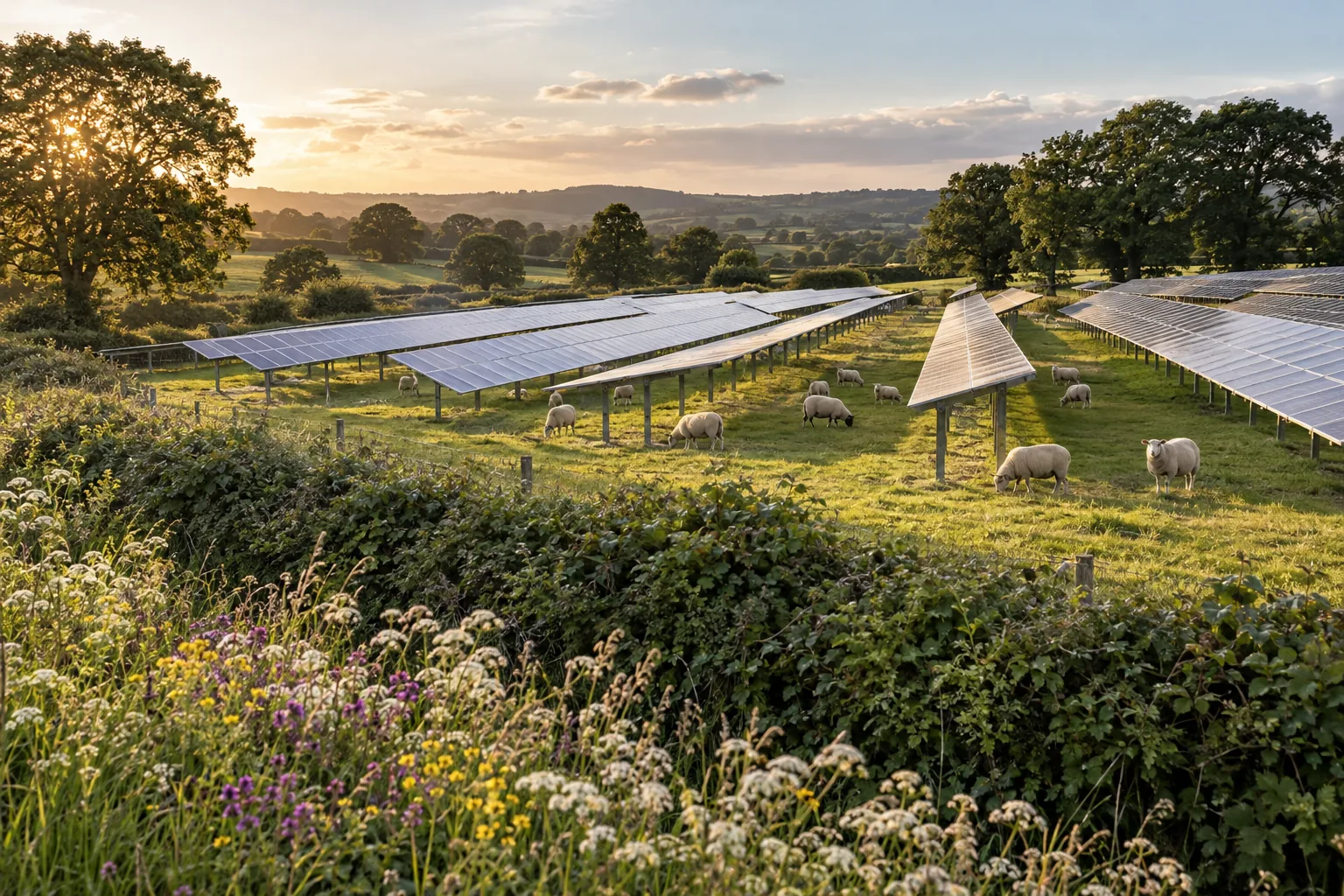
| Land | None taken out of production | Takes land, though sheep can often graze between rows |
| Cost | Usually lower per kWp on a sound roof | Frames, fencing and cable runs to the buildings add cost |
| Planning | Often permitted development | More often needs a full planning application |
| Best for | Sound, unshaded roofs close to the loads they power | Limited roof space, or demand that justifies a bigger array |
| Watch-outs | Roof condition, asbestos sheets, extra weight | Machinery access, livestock safety, visual impact, grid capacity |
Costs and payback
Farm systems are priced like other commercial solar: roughly £800–£1,200 per kWp installed, with larger systems towards the lower end. The price covers panels, inverters, mounting (roof rails or ground frames), cabling and protection, labour, design, commissioning and monitoring.
| What moves the price | Why |
|---|---|
| System size | Design, scaffolding and grid applications are spread over more kWp |
| Roof condition | Fragile or ageing sheets may need replacing or strengthening first |
| Grid connection | New switchgear, internal upgrades or DNO reinforcement |
| Distance to the loads | Long cable runs from a field array to the yard |
| Batteries | Higher cost, but more power used in the evening and overnight, for example for cold stores |
Worked example: a 50 kWp dairy roof
- Generation: 50 kWp × 1,000 kWh per kWp
- 50,000 kWh
- Used on site (80%) at 25p per kWh
- £10,000
- Exported (20%) at 5p per kWh (SEG)
- £500
- Saving in year one
- £10,500
- Installed cost at £1,000 per kWp
- £50,000
- Simple payback
- about 4.8 years
- CO₂ avoided (0.207 kg per kWh)
- about 10 tonnes a year
Assumptions: an unshaded roof that needs no work; your unit rate stays at 25p; no tax relief, finance costs or panel ageing. Try your own farm in the calculator below.
Estimate your system, cost and payback
Four numbers from your electricity bill and site. The result is an estimate to compare quotes against, not a quote.
How we work this out
- Size: 0.15 kWp per m² of usable roof or land, capped so the system makes no more than 80% of your annual use.
- Generation: kWp × typical yield for your region (South West England 1,000, London and South East 980, East of England 960, Midlands and Wales 930, North of England 880, Scotland and Northern Ireland 840 kWh per kWp a year). Shading, orientation and tilt move this by ±10%.
- Saving: 80% of generation used on site at your unit rate; the rest exported at 5p per kWh (a typical Smart Export Guarantee tariff).
- Cost: £1,000 per kWp up to 100 kWp, £900 per kWp up to 500 kWp, £800 per kWp above that, shown as a ±15% range. Roof works, grid upgrades and batteries are extra.
- Payback: mid-range cost ÷ first-year saving. No tariff rises, panel ageing, finance costs or tax relief are included.
- CO₂: generation × 0.207 kg CO₂e per kWh of grid electricity (DESNZ 2024 conversion factors).
Payback is fastest with steady daytime demand and slowest where most generation is exported. When comparing quotes, look past the headline payback to the load profile, export assumptions and maintenance included. For wider benchmarks, see commercial solar panel cost in the UK.
Grants, tax relief and funding
That leaves tax relief, export payments and finance, which together often do more than a grant would:
| Support | What it does | Status |
|---|---|---|
| Annual Investment Allowance | Deduct 100% of the cost from taxable profits in year one, up to £1 million a year. Open to sole traders, partnerships of individuals and companies. | Available |
| Full expensing | For companies: solar counts as special rate, so it gets a 50% first-year allowance, with the rest relieved over time. | Available, companies only |
| Smart Export Guarantee | Your supplier pays for every kWh you export; rates vary by supplier. | Available |
| Farm grants (England) | Improving Farm Productivity; Farming Equipment and Technology Fund | Closed, no new round announced |
| Finance, leases and PPAs | Spread the cost, or let a funder own the system and sell you the power | Through lenders and installers |
Leasing roof or land to an investor, or signing a Power Purchase Agreement (PPA), cuts upfront cost but ties you into a long contract. Involve your accountant and, where land or buildings are concerned, a land agent or solicitor before signing. Tenant farmers will need the landlord's consent. Commercial installations carry 20% VAT, which VAT-registered farms can usually reclaim. For schemes in Scotland, Wales and Northern Ireland, see solar panel grants for businesses.
Planning and grid connection
| Roof-mounted | Ground-mounted | |
|---|---|---|
| Planning | Often permitted development where panels follow the roof line. Conservation areas, listed buildings and prominent elevations can change that. | Usually a full application. Planners weigh landscape, views from roads and footpaths, nearby homes and heritage, glint and glare, and the quality of the farmland. |
| Grid | Every system needs your Distribution Network Operator's (DNO) approval to connect, and the DNO sets how much you can export. Installers normally apply for you. | |
Check planning with your council or a planning consultant before committing, especially for ground arrays.
Getting quotes from agricultural installers
PowerPilot is a matching service, not an installer. Tell us about your farm, buildings and electricity use, and whether you want roof only or a field array too. We introduce up to three installers who cover your area and handle your kind of project. Every one has had its MCS certification checked against the MCS register, its insurance confirmed and its Companies House record and trading history checked. They then survey and quote directly.
What a good farm solar quote includes
- System size (kWp) and the layout on each building or field
- Expected generation, and how much you'll use on site versus export
- The assumptions behind savings: electricity prices and operating hours
- Itemised costs, including any roof works and grid connection
- Warranties on panels, inverters and workmanship, and any maintenance plan
- Who handles planning and the DNO application
Questions to ask
- Have you installed on working farms, and can I speak to one?
- How will you schedule work around calving, lambing or harvest?
- How will you keep livestock safe and follow our biosecurity rules?
- What happens if the DNO caps our export?
- Does our roof need any work before panels go on?
For more on what good commercial quotes look like, see commercial solar panel installation and how to compare commercial solar installers.
Frequently asked questions
Are solar panels worth it for my farm?
Solar panels are often worth it for farms because they can displace a lot of daytime electricity used for milking, refrigeration, ventilation and workshops. Whether solar is worthwhile on your site depends on your demand pattern, roof or land suitability, grid capacity and installed cost. A feasibility assessment and multiple quotes will show how much generation you can use on site and how that compares with your current electricity spend.
Is it better to put solar on barn roofs or on a field?
For most farms, it makes sense to use suitable barn and shed roofs first. Roof‑mounted systems avoid taking land out of production, sit close to existing electrical infrastructure and can be simpler from a planning perspective. Ground‑mounted solar on a field is usually considered when roof space is limited or you need a larger array. It can suit poorer land or awkward corners, but you must factor in access, grazing or cropping plans and visual impact.
What do solar panels for farms cost and how long is payback?
Most farm systems cost roughly £800–£1,200 per kWp installed, ex VAT, with larger systems at the lower end. A 50 kWp system on a sound barn roof is typically around £50,000. Where most of the power is used on site in the day, payback is often around 5 years; roof works, grid upgrades and batteries add cost, and exporting most of your generation slows payback.
What grants or funding can farms use for solar panels in the UK?
As of October 2026 there is no open grant in England for on-farm solar: the Improving Farm Productivity grant, which covered solar PV, is closed. Farms can still claim the Annual Investment Allowance (100% of the cost off taxable profits in year one, up to £1 million), earn Smart Export Guarantee payments for exported power, and use loans, asset finance, leases or PPAs. Check GOV.UK's funding for farmers page for new rounds.
Do I need planning permission and a grid connection upgrade for farm solar?
Some solar on farm buildings falls under permitted development, but local planning authorities interpret the rules, and ground‑mounted arrays usually need a planning application. Grid connection always needs DNO approval; in constrained rural areas you may face export limits or reinforcement costs. A good installer will handle planning and DNO applications, but you should ask early how these factors could affect system size, export, timescales and overall viability.
How does PowerPilot choose and match farm solar installers?
PowerPilot is a matching service, not an installer. Tell us about your farm and we introduce up to three installers who cover your area and handle your kind of project. Every one has had its MCS certification checked against the MCS register, its insurance confirmed and its Companies House record checked. They survey, design and quote directly, so you can compare proposals side by side.