
Typical cost per kWp
Most commercial rooftop systems in the UK cost roughly £800–£1,200 per kWp installed, ex VAT, for straightforward projects. The bigger the system, the lower the price per kWp, because design, scaffolding and grid applications are spread over more capacity.
| System size | Typical price per kWp (ex VAT) |
|---|---|
| 10–30 kWp | £1,000–£1,300 |
| 50–150 kWp | £850–£1,100 |
| 250 kWp and over, simple roofs | £750–£950 |
Cost and payback by system size
How cost, generation and savings scale, on one set of assumptions: 950 kWh a year per kWp, 80% of the power used on site at 25p per kWh, and the rest exported at 5p under the Smart Export Guarantee (SEG).
| System size | Installed cost (ex VAT) | Generation per year | Saving per year | Simple payback |
|---|---|---|---|---|
| 20 kWp | £20,000–£26,000 | 19,000 kWh | about £4,000 | 5–6.5 years |
| 50 kWp | £45,000–£65,000 | 47,500 kWh | about £10,000 | 4.5–6.5 years |
| 100 kWp | £85,000–£110,000 | 95,000 kWh | about £20,000 | 4.3–5.5 years |
| 250 kWp | £190,000–£250,000 | 237,500 kWh | about £50,000 | 3.8–5 years |
| 500 kWp | £375,000–£500,000 | 475,000 kWh | about £100,000 | 3.8–5 years |
A sense-check, not a quote. Complex roofs, structural works, grid upgrades or batteries can move a price well outside these bands, and a site that exports more or pays less for power will pay back more slowly. Put in your own numbers:
Estimate your system, cost and payback
Four numbers from your electricity bill and site. The result is an estimate to compare quotes against, not a quote.
How we work this out
- Size: 0.15 kWp per m² of usable roof or land, capped so the system makes no more than 80% of your annual use.
- Generation: kWp × typical yield for your region (South West England 1,000, London and South East 980, East of England 960, Midlands and Wales 930, North of England 880, Scotland and Northern Ireland 840 kWh per kWp a year). Shading, orientation and tilt move this by ±10%.
- Saving: 80% of generation used on site at your unit rate; the rest exported at 5p per kWh (a typical Smart Export Guarantee tariff).
- Cost: £1,000 per kWp up to 100 kWp, £900 per kWp up to 500 kWp, £800 per kWp above that, shown as a ±15% range. Roof works, grid upgrades and batteries are extra.
- Payback: mid-range cost ÷ first-year saving. No tariff rises, panel ageing, finance costs or tax relief are included.
- CO₂: generation × 0.207 kg CO₂e per kWh of grid electricity (DESNZ 2024 conversion factors).
What drives the price
Panels are only part of the cost. Two quotes for "100 kWp" can differ by tens of thousands of pounds because of the site and what's included.
| Factor | Cheaper when | Dearer when |
|---|---|---|
| Size and layout | One large, unbroken roof area | Small or fragmented roofs with many obstructions |
| Roof and access | Pitched metal roofs with easy access | Flat roofs needing ballast; fragile or asbestos roofs; heavy scaffolding |
| Grid connection | The DNO approves the export you want | Export limits, new switchgear or network upgrades are needed |
| Equipment | Standard panels and string inverters | Premium panels, optimisers, hybrid inverters, longer warranties |
| Extras | Solar only | Batteries, EV chargers, car ports, re-roofing or board upgrades |
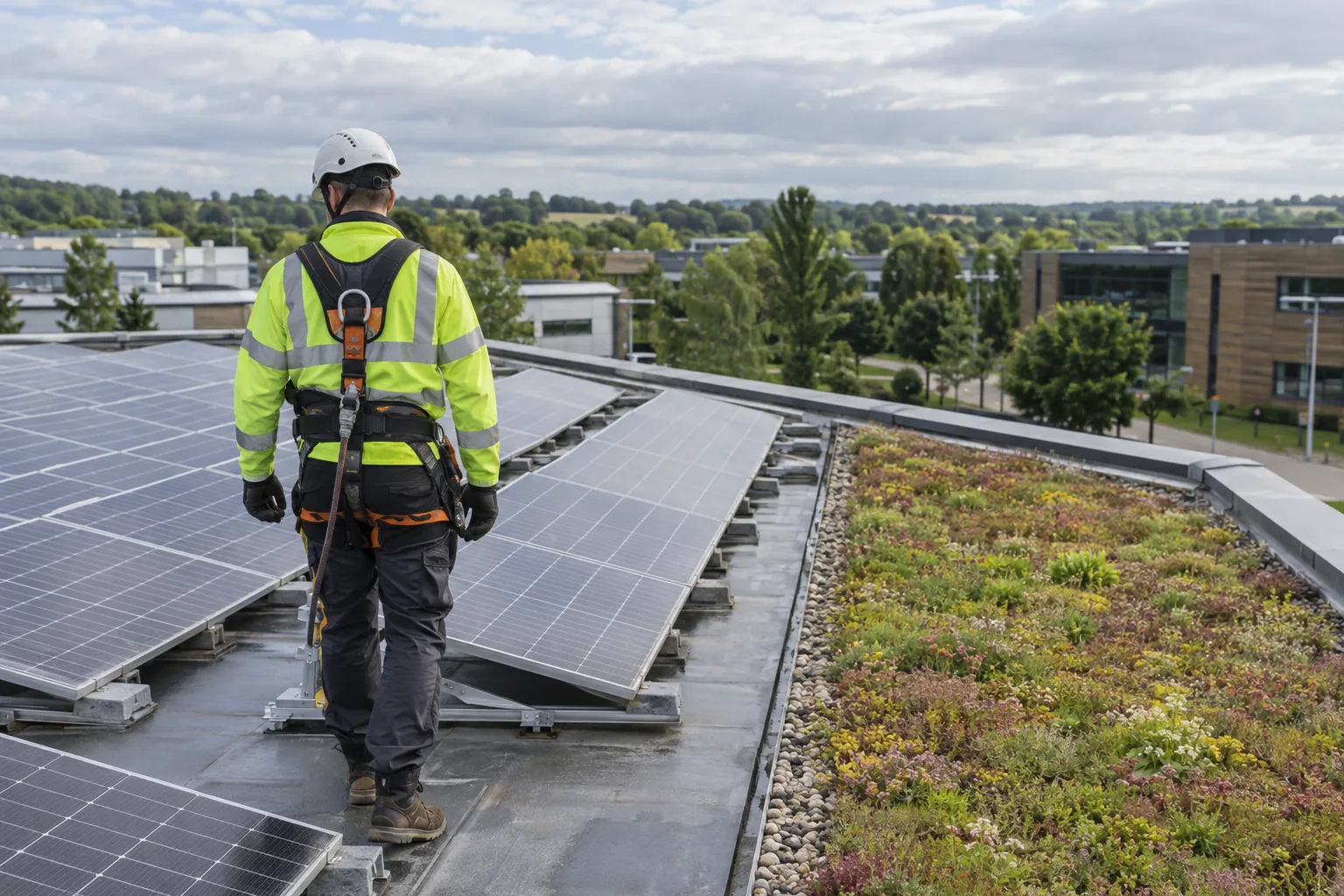
Beyond the core kit, structure and access, grid works and batteries usually move the price most.
Payback: worked examples
Payback depends on installed cost, generation, how much you use on site, your electricity price and SEG income. These examples use different tariffs on purpose; they are not quotes.
Example 1: 30 kWp on a small office or retail unit
- Cost: 30 kWp at £1,000–£1,150 per kWp
- £30,000–£34,500
- Generation: 900 kWh per kWp
- 27,000 kWh
- Used on site (75%) at 30p per kWh
- £6,075
- Exported (25%) at 7p per kWh
- £473
- Saving per year
- about £6,550
- Simple payback
- 4.6–5.3 years
Example 2: 250 kWp on a warehouse or factory
- Cost: 250 kWp at £800–£1,000 per kWp
- £200,000–£250,000
- Generation: 900 kWh per kWp
- 225,000 kWh
- Used on site (90%) at 28p per kWh
- £56,700
- Exported (10%) at 7p per kWh
- £1,575
- Saving per year
- about £58,300
- Simple payback
- 3.4–4.3 years
How on-site use changes payback
The same 100 kWp system (95,000 kWh a year, £95,000 installed, 25p import, 5p export) at three levels of on-site use:
| Used on site | Saving per year | Simple payback |
|---|---|---|
| 60% | about £16,150 | about 5.9 years |
| 75% | about £19,000 | about 5 years |
| 90% | about £21,850 | about 4.3 years |
Every unit you use yourself is worth five times one you export, so daytime demand matters more than almost anything else. Payback is longer where demand is low, roofs are shaded or DNO upgrades are expensive. For farm examples, see solar panels for farms.
Tax relief, SEG and finance
Capital allowances
Solar panels are special rate plant and machinery for capital allowances. Two routes give fast relief:
| Allowance | Who | Relief on solar |
|---|---|---|
| Annual Investment Allowance | Most businesses, including sole traders and companies | 100% in year one, up to £1 million a year |
| Full expensing | Companies only | 50% first-year allowance (solar doesn't get the 100% rate) |
- Claimed under the AIA
- £200,000
- Corporation tax saved at 25%
- £50,000
- Net cost after tax relief, before energy savings
- about £150,000
If the AIA is already used up, the 50% first-year allowance gives £100,000 of relief in year one instead, with the rest spread over later years. The main rate of corporation tax is 25%; smaller profits pay less, so the saving is smaller. Check with your accountant.
Smart Export Guarantee (SEG)
Under the Smart Export Guarantee, licensed suppliers pay for the electricity you export, for systems up to 5 MW. Rates vary by supplier and are well below what you pay to import, so SEG adds modest income and matters most where you export a lot.
Finance options
| Buy outright | Asset finance or lease | Power Purchase Agreement | |
|---|---|---|---|
| Upfront cost | Full cost | Little or none | None |
| Who owns it | You | Depends on the structure | The funder |
| Capital allowances | You claim | Depends on the structure | The funder claims |
| Lifetime saving | Highest | Lower, after interest and fees | Lowest, but immediate |
For other support, including grants, see solar panel grants for businesses.
Ongoing costs
Commercial solar runs for 25 years or more, so build running costs into the numbers:
| Cost | What it covers | How often |
|---|---|---|
| Operations and maintenance (O&M) | Inspections of fixings, cabling and inverters; monitoring; fault response | Annual contract or per visit |
| Cleaning | Dirt, bird fouling or industrial grime that cuts output | Where needed; rarely on clean, rainy sites |
| Inverter replacement | Inverters last about 10–15 years; panels carry 20–25 year performance warranties | At least once over the system's life |
| Insurance | Adding the system to your buildings cover; insurers may ask for MCS or equivalent paperwork | Annual |
Many businesses set aside part of each year's saving for the inverter replacement.
Getting tailored quotes
Benchmarks only go so far: a real price needs a survey of your roof, your demand and your grid connection. PowerPilot is a free matching service, not an installer. We introduce up to three installers who cover your area and handle your kind of project. Every one has had its MCS certification checked against the MCS register, its insurance confirmed and its Companies House record checked.
Share your details
Your site, roof type, rough electricity use and any constraints. Photos or plans help.
Installers assess the site
Each starts with a desktop survey from aerial imagery and your bills, then visits if the project looks viable.
Compare the quotes
Each comes with its own design, cost breakdown and generation estimate.
When you compare, check:
- System size (kWp) and expected generation (kWh)
- Total cost and price per kWp, including DNO works and extras
- What's included: scaffolding, monitoring, O&M, warranties, planning and DNO applications
- The assumptions behind savings: on-site use, tariffs, panel ageing
Thinking about storage too? See solar battery installers.
Frequently asked questions
How much does a 50 kWp commercial solar system cost in the UK?
On a straightforward commercial roof, a 50 kWp system typically costs around £45,000–£65,000 ex VAT, generating roughly 42,500–50,000 kWh per year. Site specifics such as roof type, access, DNO requirements and extras like batteries can move quotes outside this range. Use the cost‑by‑size table above to benchmark any proposal.
How much does a 100 kWp commercial solar system cost in the UK?
Many UK businesses see 100 kWp quotes in the region of £85,000–£110,000 ex VAT on simple roofs. Annual generation is usually 85,000–100,000 kWh, with indicative payback of 4–8 years depending on self‑consumption and tariffs. More complex roofs or grid upgrades increase cost, so compare site‑specific designs rather than headline figures.
What is the typical cost per kWp for commercial solar in the UK?
Most commercial rooftop systems fall between £800 and £1,200 per kWp ex VAT. Smaller or complex projects tend to sit at the top of that range; large, simple roofs at the bottom. These are indicative benchmarks only. See the “Typical commercial solar panel cost per kWp” section to sense‑check any business solar panels cost quote.
What is the usual payback period for commercial rooftop solar?
On current business electricity prices, many commercial systems pay back in around 4–8 years, assuming good daytime use and no major grid upgrade costs. Low daytime demand, shading, cheap tariffs or high grid charges stretch it. The worked examples and the on-site use table above show how much each factor matters.
What ongoing costs should we expect after installing commercial solar?
Expect periodic inspections, performance monitoring and occasional cleaning, either in‑house or via an O&M contract. Inverters usually need replacing at least once over a 20‑plus‑year life, and buildings insurance may need updating to cover the PV system. These costs are modest relative to lifetime savings but should be included in your ROI assessment.