
Solar batteries at a glance
The short answers. Each links to the detail further down.
| Question | Short answer |
|---|---|
| What does a battery cost? | About £4,600 for a typical 5 kWh battery, fitted. Costs |
| What size do I need? | Roughly your evening and overnight use: 5–10 kWh for most homes. Sizing |
| Is it worth it? | Most where you're out in the day, use a lot in the evening or can use a cheap overnight tariff. Who it suits |
| Can I add one to existing panels? | Yes, with a hybrid inverter or an AC-coupled battery. Options |
| Is there VAT? | No: 0% on home batteries until 31 March 2027, with or without panels. VAT |
| Will it power my home in a power cut? | Only if it's designed for backup. Many aren't. Backup |
Do you need a battery?
A battery stores surplus solar, or cheap overnight electricity, so you buy less from the grid at expensive times. It adds most value when that matches how you use power.
A strong fit
- You're out in the day, so most solar would be exported
- Heavy evening use: cooking, showers, an electric car
- A heat pump or electric heating, now or planned
- You can use a cheap overnight or time-of-use tariff
A weaker fit
- Low electricity use overall
- You're home all day and already use most of your solar
- A tight budget: panels alone pay back sooner on a flat tariff
- Nowhere suitable to put it
| Option | How it works | Good to know |
|---|---|---|
| With new panels | A hybrid inverter runs both | Usually the simplest and cheapest way to add one |
| Added to existing panels | A hybrid inverter replaces yours, or an AC-coupled battery sits alongside it | The installer checks your inverter's age and your grid connection |
| A battery on its own | Charges from the grid overnight, used at peak times | Only pays with a tariff that has a big gap between cheap and peak rates |
Sizing a battery to your home
Battery size is in kilowatt-hours (kWh). Look at the usable capacity, which is a little below the headline figure. A good starting point is how much you use from late afternoon until morning.
| Home | Use a day | Typical usable battery |
|---|---|---|
| Low use: a flat or small home | About 5–6 kWh | 3–5 kWh |
| Typical: Ofgem's medium home, 2,700 kWh a year | About 7–8 kWh | 5–8 kWh |
| High use: a bigger home, or an electric car or heat pump | 11 kWh or more | 10 kWh or more |
Installers size it from 12 months of bills, half-hourly smart meter data if you have it, and any changes you're planning. Too small and it runs out early in the evening; too big and some of it sits unused for much of the year. Ask each installer to show you two sizes, so you can see what the bigger one actually adds.
What a battery costs
| System | Typical cost |
|---|---|
| 5 kWh battery, fitted | About £4,600 (from about £1,500 to £10,000 by size and brand) |
| 4 kWp of panels with a battery | About £9,000–£13,000 |
| Larger panels and a 10 kWh+ battery | £13,000 and up |
Battery cost is from the Energy Saving Trust; system prices match our solar panel quotes guide. Prices rise with battery size and brand, a new consumer unit, long cable runs, backup hardware and longer warranties.
Estimate your system, cost and payback
A few details about your home and bill. The result is an estimate to compare quotes against, not a quote.
How we work this out
- Size: 1–2 bedrooms 3 kWp, 3 bedrooms 4 kWp, 4 or more bedrooms 5 kWp. Your installer sizes it to your roof.
- Generation: kWp × typical yield for your region (South West England 1,000, London and South East 980, East of England 960, Midlands and Wales 930, North of England 880, Scotland and Northern Ireland 840 kWh per kWp a year), then 100% of that for a roof facing south, 95% of that for a roof facing south-east or south-west, 85% of that for a roof facing east or west. Shading moves this too.
- Used at home: mostly out 30%, some days 45%, mostly in 60% of what the panels make. A battery adds 30 points, up to 85%, and never more than 90% of your annual use.
- Saving: power used at home at your unit rate; the rest exported at 8p per kWh. Smart Export Guarantee tariffs range from about 2p to 15p, so shop around.
- Cost: £1,000 plus £1,450 per kWp, and £4,500 for a battery, shown as a ±15% range. Based on Energy Saving Trust figures, with 0% VAT until 31 March 2027.
- Payback: mid-range cost ÷ first-year saving. No price rises, panel ageing or time-of-use tariffs are included; a battery pays back faster on a cheap overnight tariff.
- CO₂: generation × 0.207 kg CO₂e per kWh of grid electricity (DESNZ 2024 conversion factors).
Tick "Add a battery" above to see the difference it makes. On a flat-rate tariff a battery usually lengthens payback; on a tariff with cheap overnight rates it can shorten it. For panel prices in detail, see solar panel cost in the UK.
Tariffs: when a battery really pays
A battery earns its keep in two ways:
Storing surplus solar
Instead of exporting spare power at a few pence under the Smart Export Guarantee, you use it in the evening and avoid paying your full unit rate.
Charging cheaply overnight
On a time-of-use tariff, it charges in the cheap window and runs the house at peak times. The bigger the gap between the two rates, the more it saves.
Your part: check which tariffs your supplier offers, and whether you could run the car or washing at night.
| Tariff | How it's priced | Battery value |
|---|---|---|
| Flat rate | The same price all day | Only from storing your own solar |
| Time-of-use | A cheap overnight window, dearer the rest of the day | Good: store solar and charge cheaply |
| Dynamic | Changes every half hour with wholesale prices | Best for people happy to automate charging |
You still get export payments with a battery; you just export less. Ask your supplier how it treats export from a home with a battery.
Choosing a battery installer
- Accreditations: MCS certification, ideally covering battery storage as well as solar, a consumer code such as RECC or HIES, and TrustMark.
- Battery experience: how many they've fitted, which brands they know, and homes like yours.
- Itemised quote: panels, inverter, battery and its usable capacity, scaffolding, electrical work, monitoring and aftercare.
- Warranties: separate product warranties for the panels, inverter and battery, plus a workmanship warranty.
Questions to ask
- How did you size the battery to my use, and what would a size bigger or smaller change?
- What tariff have you assumed in the savings?
- Will it work in a power cut? If so, what will it power?
- Will your own team fit it, or subcontractors?
- What's excluded, such as a consumer unit upgrade?
- Who do I call if it fails, and who deals with the manufacturer?
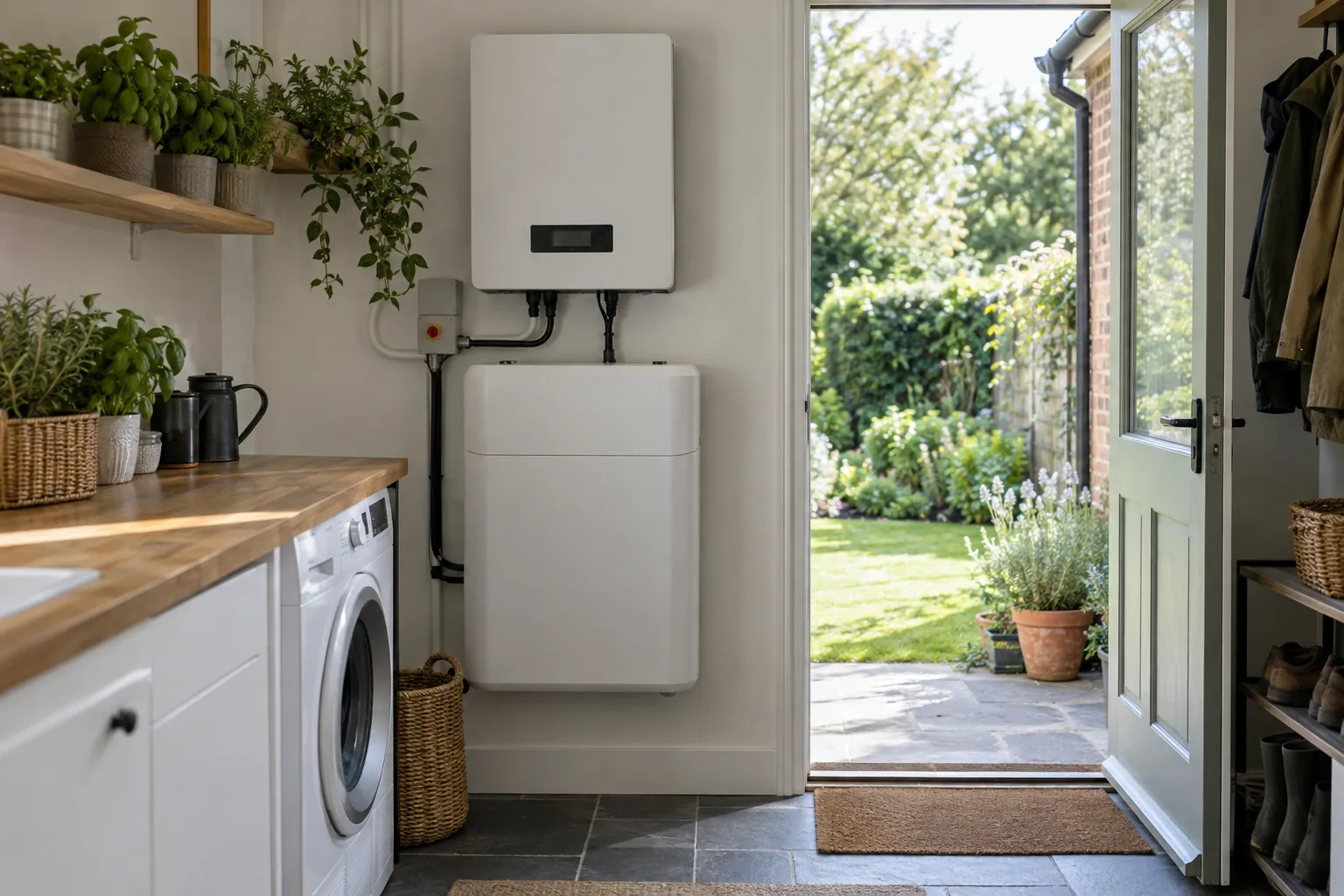
For more on checking installers, see MCS-certified solar panel installers near you.
Getting battery quotes
Tell us your type of home and whether you want a battery with panels or on its own. We introduce you to up to three installers who cover your area, and there's no obligation to go ahead.
To get the most from their quotes, have to hand:
- 12 months of bills or smart meter data
- Photos of your fuse box
- Photos of your roof and loft
- Details of any existing panels and inverter
- Plans for an electric car or heat pump
Compare battery size, brand, warranties, backup and monitoring, not just the headline price. New to solar? Start with solar panels for your home.
Frequently asked questions
How much does a solar battery cost?
About £4,600 for a typical 5 kWh battery, fitted, according to the Energy Saving Trust, with a range of about £1,500 to £10,000 by size and brand. With 4 kWp of panels, expect about £9,000–£13,000. Home batteries have 0% VAT until 31 March 2027.
Is it worth adding a battery to my existing solar panels?
Often, if you export a lot in the day and buy power back in the evening, or can use a cheap overnight tariff. An installer checks your inverter and grid connection, then adds a hybrid inverter or an AC-coupled battery.
What size battery do I need?
Roughly what you use from late afternoon to morning. Most homes look at 5–8 kWh usable; homes with an electric car or heat pump often go to 10 kWh or more.
Will a solar battery work in a power cut?
Only if it's designed for backup. Most systems shut down in a power cut. Ask installers for backup specifically and what it will power.
Is there VAT on a battery on its own?
No. Home batteries are zero-rated until 31 March 2027, whether fitted with panels, added to existing panels or installed on their own to charge from the grid.
Do I need an MCS-certified installer?
For Smart Export Guarantee payments, your solar installation needs to be MCS-certified. Using an MCS installer for the battery keeps the paperwork straightforward, and many are certified for battery storage too.